
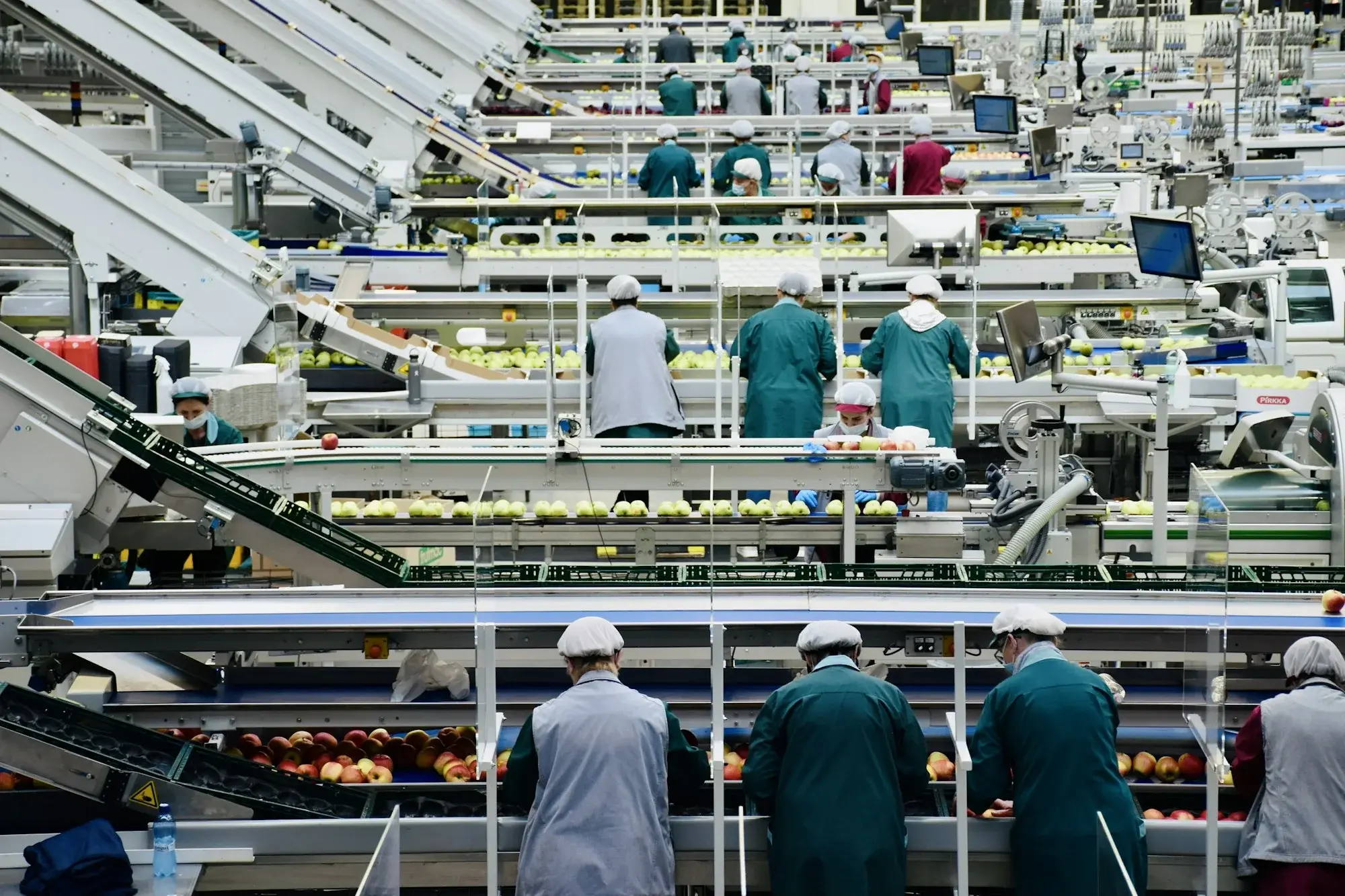
Food and drink manufacturing is a business where time matters in a very practical way. Ingredients arrive with their own dates. Batches are mixed, cooked, filled or baked to a recipe, then labelled with a date that starts a clock for the customer. Retailers send orders with specifications, delivery windows and rules about how much life a product must have left when it arrives. Keeping all of that accurate is the core job of an ERP for food and drink manufacturers.
Many food businesses start with a recipe book, a batch sheet pinned to the wall, a goods-in log kept by hand and a spreadsheet for shelf life. Each one works while the team is small and everyone knows the products by heart. The trouble starts when two people hold different versions of the same recipe, a supplier changes a lot without warning, or a retailer asks which batches went into one particular delivery. At that point the answer has to come from records, not from anyone's memory.
This guide sets out what an ERP for food and drink manufacturers should hold together, and what to test before choosing one. It is written for owners, operations managers and production leads who want fewer gaps between the factory floor and the office. It does not replace advice from your own food safety specialists, but it should help you ask sharper questions of any system you consider.
Recipes, versions and yield as the starting point
Everything in a food business begins with the recipe. If the recipe is wrong, the costings, allergen information, labels and stock requirements built on top of it are wrong as well. An ERP gives the recipe a home that the whole business shares, so production, purchasing and the office all work from the same version.
One master recipe with controlled versions
A useful recipe record holds the ingredients and quantities, the yield the process is expected to produce, the pack format and a version number with its effective date. When a recipe changes, the new version should be approved before it is used, and the old version should stay on record for every batch made under it. That history matters when a customer asks exactly what went into a product made months earlier.
Yield deserves attention too. If a recipe expects a certain output per batch but the line regularly produces less, the gap shows up as lost product and understated cost. Recording actual yield against the recipe makes that gap visible, instead of leaving it buried in month-end figures.
Scaling and substitutions
Production often scales a recipe up or down, and sometimes swaps one ingredient for another when a supply problem appears. Both changes need to flow through to purchasing requirements, the allergen check and the label. A substitution made on the floor that never reaches the record is a common way for a food business to end up with information that does not match the product in the box.
Batch and lot tracking from goods-in to dispatch
Batch and lot tracking links what came into the building with what went out of it. In practice the two words are often used loosely. A supplier lot is the identifying number on an ingredient delivery. A production batch is the run the business makes from those ingredients. A good ERP connects the two, so that every finished pack can be traced back to its ingredient lots and every ingredient lot can be followed forward to the packs it went into.
Recording lot codes at goods-in
Traceability is either built at goods-in or lost there. Each delivery should be recorded with enough detail to answer questions months later:
- The supplier and the supplier's own lot or batch number
- The use by or best before date printed on the delivery
- The quantity received and the unit it was counted in
- Any certificate of analysis or specification supplied with it
- The storage location and quality status, such as released, on hold or rejected
A quality hold matters as much as the receipt itself. Stock waiting for a test result should not be available to production until it is released, and the system should make that status impossible to miss.
Batch records that connect ingredients to packs
Each production batch needs a record that links the recipe version, the ingredient lots actually used, the process checkpoints, the yield and the finished product code. Where batch sheets are kept on paper, the information is often correct but impossible to search. Once it is entered against the batch number, one search can show every pack that came from a given ingredient lot.
Shelf life and stock rotation that protect the customer
Shelf life is the detail customers, retailers and inspectors notice first. It starts at production, and the remaining life of a product at dispatch often decides whether a delivery is accepted. An ERP should calculate and record shelf life in a way the warehouse, the sales team and finance can all rely on.
Use by and best before dates
UK labelling makes a practical distinction between use by dates, which apply to highly perishable foods that may be unsafe after that date, and best before dates, which describe quality. The system should store which type applies to each product, calculate the date from the production date and the stated shelf life, and pass that date to the label process. Getting the type wrong is a labelling problem, so the rule belongs in the product record rather than being typed by hand for each run.
Picking by expiry rather than by arrival
Stock rotation is where many food businesses lose product without noticing. If the warehouse picks the oldest delivery by arrival date while a newer delivery has a shorter life, the short-dated stock sits until it can no longer be sold. First expired, first out, usually shortened to FEFO, is the common approach. An ERP can be set up so that picking suggestions follow expiry dates rather than the order in which goods were received.
Remaining shelf life at dispatch needs its own check. Some retailers set a minimum remaining life when goods are delivered, and a load that falls short can be refused. The dispatch step should show the remaining life of each lot before the load leaves, so the decision is made in the warehouse and not at the customer's loading bay.
Allergens and labels handled as controlled data
Allergen control is both a legal duty and a food safety matter. The rules set out which allergens must be declared and how, and businesses should take advice from their own food safety specialists or the local authority on how labels should be written. The ERP's job is to keep the information consistent, so that the recipe, the ingredients and the label all say the same thing.
Allergen information held against ingredients
A practical setup holds the allergen profile against each ingredient and carries it up into every recipe that uses it. When a supplier changes a formulation, the profile for that ingredient is updated and the affected recipes are flagged for review. That is more dependable than relying on someone to remember which products contain the changed ingredient.
Label versions and packaging control
Labels change more often than many teams expect. A new supplier, a new recipe version or a new pack size each means a new label, and old labels must not be used once the change has been approved. Linking each label version to the product and recipe version it applies to, and recording when the old stock was stopped, gives the business a clear answer when someone asks which label was on which batch.
Recall readiness for food and drink manufacturers
A product recall is thankfully rare, but when one happens the speed of the response matters. Records either answer the questions quickly or they do not, and the difference shows in the time taken, the amount of product that has to be pulled and the confidence of customers and regulators. Recall readiness depends less on the software than on whether the business has tested its records before the day it needs them.
Trace one step back and one step forward
UK food law expects a food business to be able to identify where its ingredients came from and where its products went, one step back and one step forward. An ERP that joins supplier lots, production batches, stock locations and customer deliveries makes that possible in minutes rather than through a series of phone calls and a filing cabinet. Take advice from your own specialists on exactly what your traceability records must show.
Running a mock recall
A mock recall is a practice exercise. Certification audits often ask to see evidence of a traceability test, and the exercise is useful even when no audit is due. A simple version follows a set routine:
- Pick one finished batch and note its pack code and date
- Trace it back to every ingredient lot used in that batch
- Trace it forward to every customer delivery that included the batch
- Time each step and note where the information was hard to find
- Record the gaps, name an owner for each fix and repeat the test
The written record matters as much as the result. A timed test that shows what was found and what was fixed is useful evidence that the business takes traceability seriously.
Retailer orders that food manufacturers must meet
Supermarkets, convenience chains and wholesalers often set detailed requirements for their suppliers. Those requirements shape how orders are entered, how products are packed and how deliveries are planned. An ERP that holds them against each customer and product saves a surprising amount of back and forth.
Specifications and barcodes
Retail customers usually expect a product specification covering ingredients, allergens, shelf life, pack format, weights and labelling. Each product also needs the right barcode. In the UK that is normally a GTIN issued through GS1, and the number must match the one the retailer holds on file. Keeping specifications and barcodes in the product record means the sales team does not have to rebuild them from old emails each time an order arrives.
Case, pallet and delivery window rules
Orders are often placed in cases or pallets, while production and stock may be counted in units or kilograms. The system should hold the conversion between those units, the case and pallet build, and the delivery window the customer requires. Certification schemes such as BRCGS Food Safety also shape what suppliers are asked to show, so certificates and audit dates should sit where both the sales and quality teams can see them.
FAQ
What is the difference between batch and lot tracking?
The terms are often used loosely in food manufacturing. A lot usually refers to an ingredient or packaging delivery identified by the supplier, while a batch is a production run the business makes. A good ERP records both, so every finished product can be traced to the lots that went into it.
Does a food manufacturer need an ERP system?
Not necessarily from the start. A small kitchen or bakery can often manage with careful records for a while. An ERP becomes worth considering when recipes, lots, shelf life and customer orders are spread across too many tools to check quickly.
How does an ERP help with a product recall?
A system that links supplier lots, production batches, stock locations and customer deliveries can answer the key questions in minutes rather than hours. It does not replace your recall procedure or your food safety advisers. It gives your team the information they need to carry the procedure out quickly and accurately.
What is FEFO and can an ERP support it?
FEFO stands for first expired, first out. Stock with the earliest expiry date is picked and sold first, rather than the stock that arrived first. An ERP can usually be set up to suggest picks in that order, although the exact set-up depends on the products and how the warehouse works.
Can an ERP hold allergen information for each product?
An ERP can usually be set up to hold allergen data against ingredients and recipes, so that a change to an ingredient prompts a review of the products that use it. The data is only as good as what is entered, and final labels should be checked against current rules with your food safety advisers. Treat the system as a control, not a substitute for expert advice.
What do UK retailers usually ask food suppliers for?
Retailers commonly ask for a product specification, allergen and shelf life information, barcodes, pack and case details, and evidence of food safety certification. Delivery windows and a minimum remaining shelf life on arrival are also common requirements. Keeping these in one product record makes orders quicker to accept and easier to check.
Final thought
An ERP for food and drink manufacturers is worth serious consideration when recipes, lot records, shelf life and customer requirements are spread across too many places to check quickly. The aim is not a bigger system for its own sake. It is a record that answers the practical questions on a busy day, such as which lot went where, what a product contains and how much life is left.
The tests that matter most are a recipe change, a supplier lot problem and a mock recall. Those will show where information is lost, and they make a stronger brief than a long list of features.
If you are weighing up this kind of system, Mirex Agency can help you map your recipes, lots and customer requirements before anything is chosen. Our ERP solutions service is designed to bring those records into one clearer system that your team can trust on the factory floor and in the office.


